
Potential customers are no longer discovering businesses through one search format. They may use traditional Google results, Google’s AI experiences, ChatGPT search, maps, social platforms, or a combination of all of them before making contact. That shift has created intense interest in AI visibility submissions. The important truth is that no special submission can guarantee a citation or recommendation.
AI search visibility begins with the same foundation that has always supported sustainable organic growth: a website that can be crawled, understood, trusted, and used easily. An optimized WordPress site provides that foundation. Distribution and submission tools can help search systems discover changes, but they cannot compensate for thin content, unclear services, technical barriers, or weak credibility.
What AI Search Visibility Means
AI visibility is the ability of a brand, service, product, or expert to be discovered and accurately represented in AI-powered search experiences. It can include being cited as a source, appearing in a linked result, being summarized in an answer, or being recognized as a relevant business for a specific need.
Visibility is not the same as a guaranteed ranking. AI systems can use multiple queries, sources, and formats to assemble a response. Results may change based on the wording, user context, location, and freshness of available information. The best strategy is to make the website consistently clear and useful across many relevant questions.
There Is No Special Google AI Submission
Google states that the same foundational SEO practices apply to AI Overviews and AI Mode. Its AI features guidance says there are no additional technical requirements, special AI files, or special schema needed. A page must be indexed and eligible to appear with a snippet in Google Search.
That means businesses should be cautious of services promising automatic placement through a proprietary AI submission. Legitimate work focuses on discovery, crawl access, indexing, content quality, structured data that matches visible content, internal linking, and accurate business information. Those actions improve eligibility; they do not purchase inclusion.
Make WordPress Easy to Crawl and Index
Start by confirming that important pages return a successful status, are not blocked by robots directives, and use the correct canonical URLs. Maintain an XML sitemap and submit it through search-engine webmaster tools. Use clear internal links so crawlers can reach every valuable service, location, case study, and resource page without relying on a search box or complicated script.
WordPress makes publishing easy, but plugins and settings can accidentally create duplicate archives, thin tag pages, conflicting canonicals, or noindex directives. A technical audit should identify which pages deserve to be indexed and which pages should remain out of search results. Cleaner indexation helps systems focus on the content that represents the business best.
Allow the Crawlers You Want
OpenAI explains that public websites can appear in ChatGPT search and recommends allowing OAI-SearchBot when a publisher wants content to be discovered and cited. Its publisher guidance also notes that ChatGPT referral URLs include utm_source=chatgpt.com, which can help businesses measure visits in analytics.
Crawler access should be an intentional business decision. Review robots.txt, security tools, firewall rules, and hosting controls together. A bot may be allowed in robots.txt yet blocked by a security layer, or the reverse. Keep protections against abusive traffic while ensuring approved search crawlers can retrieve the pages you want discovered.
Create Content That Can Be Understood and Quoted
Each page should answer a specific audience need. Use a descriptive title, a direct introduction, logical headings, plain-language explanations, and factual details. Define important terms, answer common follow-up questions, and explain limitations. This structure helps people scan the page and gives search systems clearer passages to interpret.
Strong content demonstrates first-hand knowledge. Include original examples, process details, service boundaries, local experience, case studies, author information, and evidence for measurable claims. Avoid filling pages with generic AI-generated language. If the same paragraph could describe any company, it is unlikely to establish why your business should be trusted.
Use Structured Data as Confirmation
Schema markup can help search engines understand entities and page types, but it is not a secret AI ranking switch. Add appropriate structured data for the organization, local business, articles, breadcrumbs, services, or other eligible content, and make sure every claim in the markup is also visible to visitors. Incorrect or exaggerated schema can create confusion rather than authority.
Keep the business name, contact information, service descriptions, author details, and profile links consistent. Update Google Business Profile and other important listings when hours, addresses, or services change. Consistency makes it easier to connect the website with the same real-world entity across the web.
Performance and Accessibility Strengthen the Foundation
A slow or unstable WordPress site wastes the opportunity created by search visibility. Optimize images, reduce unnecessary scripts, use reliable caching and hosting, and monitor Core Web Vitals. Ensure essential content is present as crawlable text rather than trapped inside images, videos, or interactions that require several clicks.
Accessibility also improves clarity. Use semantic headings, descriptive link text, image alt text, labeled forms, keyboard-friendly navigation, and readable contrast. OpenAI notes that accessibility practices such as ARIA markup can help ChatGPT’s agent understand site structure and interactive elements. More importantly, they make the site usable for more potential customers.
Build Authority Beyond Your Own Website
AI-powered results often rely on a broader information environment. Earn legitimate mentions, links, reviews, interviews, association profiles, and local coverage. Publish resources worth referencing, then share them where the intended audience already looks for answers. Authority grows when independent sources consistently confirm the expertise and identity presented on the website.
For local companies, connect service pages, location information, customer proof, and map profiles. For professional firms, strengthen expert biographies, credentials, publications, and case studies. For ecommerce brands, maintain accurate product data, policies, and merchant information. The exact signals differ, but the principle is the same: make the claim easy to verify.
Measure Visibility as Part of the Customer Journey
Track organic clicks, qualified leads, assisted conversions, branded searches, and referral traffic from AI platforms. Review which pages attract visitors and whether those visits result in calls, forms, or sales. Citation monitoring can reveal useful patterns, but it should not replace business outcomes.
Document important prompts and questions customers use, then revisit them periodically. Results can vary, so look for trends instead of treating one answer as a permanent score. Use the findings to improve missing explanations, publish stronger evidence, and clarify the pages that should represent each service.
The Winning Combination
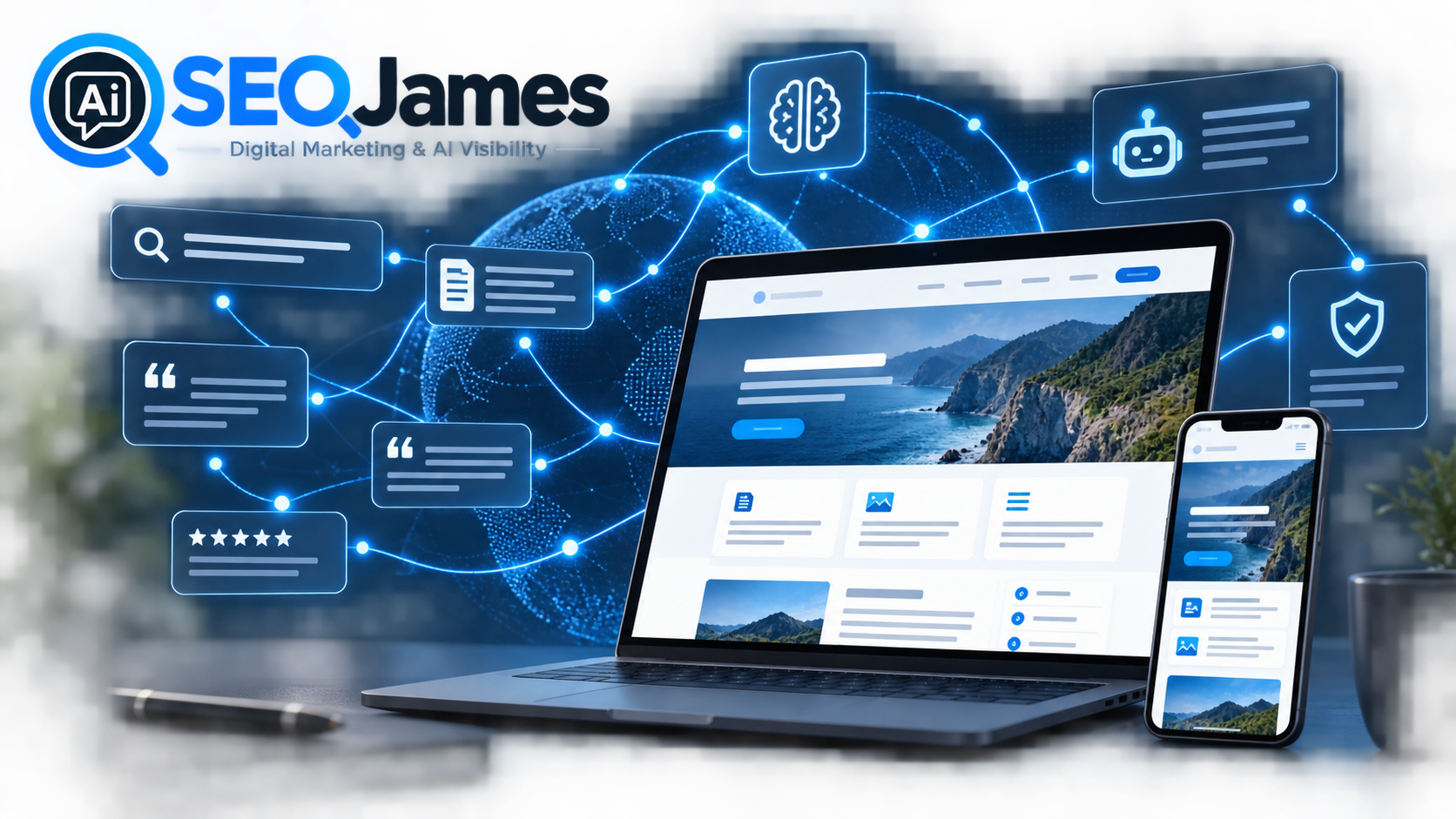
AI discovery and WordPress optimization work best as one strategy. Discovery controls help eligible systems find the site. Technical SEO helps them crawl and index it. Structured, useful content helps them understand it. Authority signals help establish trust. Mobile performance and conversion design turn that visibility into business.
SEO James combines WordPress development, SEO, local search, content strategy, and AI visibility into a coordinated plan. The goal is not to chase a new label or promise guaranteed placement. It is to build a durable website that search engines, AI systems, and—most importantly—prospective customers can understand and trust.