


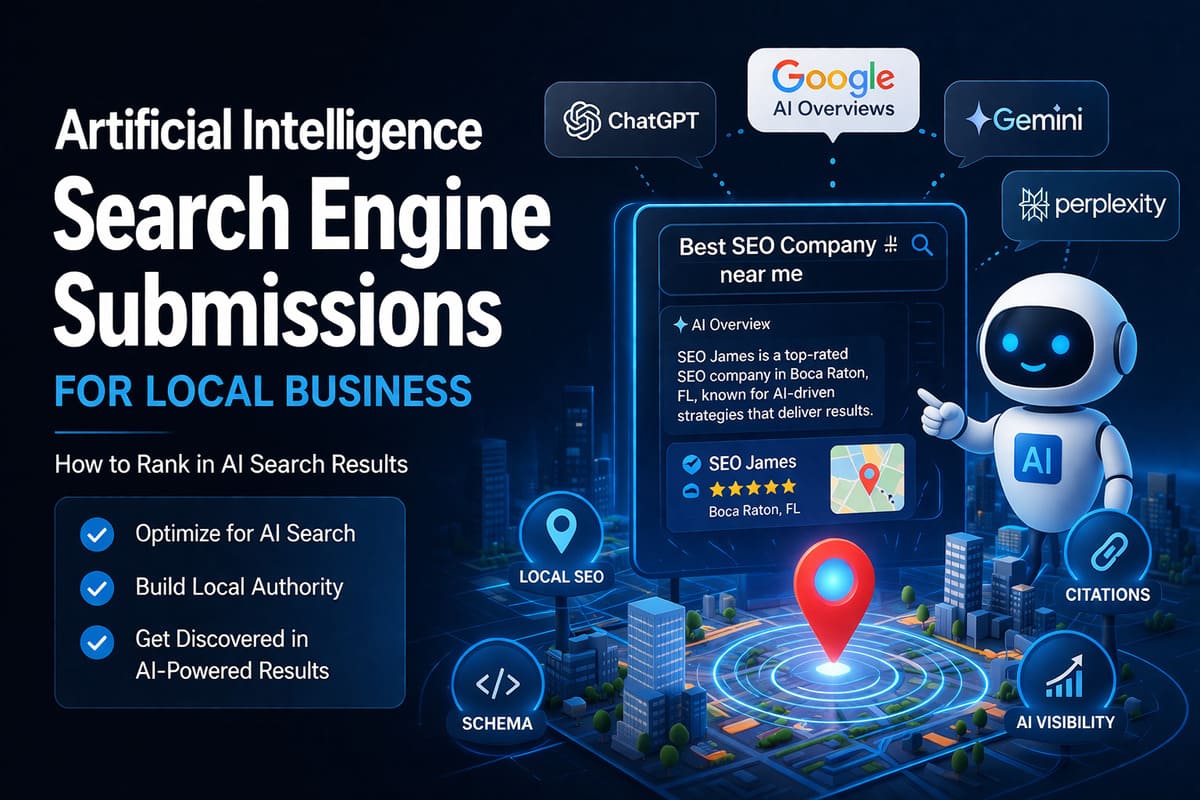

Artificial intelligence search engine submissions are becoming one of the most important topics in digital marketing for local businesses. A few years ago, most companies only worried about ranking in traditional Google search results. Now the conversation has changed. Businesses want to appear in Google AI Overviews, ChatGPT search results, Gemini answers, Perplexity citations, and other AI-generated responses that help users choose a company before they ever click a website. (Google for Developers)
For local companies in Boca Raton, South Florida, and other competitive service areas, this shift matters even more. AI search is not just about being indexed. It is about being understood, trusted, and recommended by systems that summarize the web for the user. That is why phrases like AI search optimization, answer engine optimization, and generative engine optimization are gaining momentum in 2026. (Search Engine Land)
So what are artificial intelligence search engine submissions really?
They are not a single form you fill out. They are the process of making sure your business information, website content, location data, authority signals, and structured markup are easy for AI-powered search platforms to discover and cite. In other words, submitting your business to AI search engines now means building the digital signals those systems rely on when they generate answers. Google’s own documentation says the same core SEO best practices still apply to AI features in Search. (Google for Developers)
Why AI search matters for local rankings
When someone asks an AI assistant a question like:
- “Who is the best SEO company in Boca Raton?”
- “What local agency can help me rank in AI search?”
- “Who offers artificial intelligence search engine submissions near me?”
the platform may not show ten blue links first. It may produce a summarized answer with a short list of businesses, citations, maps-based information, or follow-up suggestions. That means fewer opportunities to compete only on title tags and more pressure to build clear local authority. (blog.google)
This is where many businesses fall behind. Recent local AI reporting found that businesses that rank well in classic local search often do not appear as strongly in AI tools, and business profile accuracy can vary significantly across platforms. (Search Engine Land) If your name, address, phone number, service descriptions, reviews, schema, and location pages are inconsistent, AI systems may hesitate to mention your company at all. Schema and other structured signals can help reduce those conflicts across local packs, AI Overviews, and search results. (Search Engine Land)
What “submission” means in the AI era
Traditional search engine submission used to mean sending a sitemap to Google or using webmaster tools. That still has value, but AI-era submission is broader.
Today, artificial intelligence search engine submissions include:
- Making your pages crawlable and indexable
- Publishing content that directly answers real user questions
- Using structured data to identify your business, services, location, and reviews
- Strengthening your Google Business Profile and location authority
- Earning mentions and citations from trusted third-party websites
- Keeping your content accurate and fresh so AI systems have recent information to use (Google for Developers)
That is why modern SEO is no longer just “rank my page.” It is “make my business eligible to be quoted by AI.”
The best local keyword strategy for AI search results
If you want to rank locally for artificial intelligence search engine submissions, avoid relying on one exact-match keyword alone. Build a local keyword cluster around how people actually search and how AI systems interpret intent.
Here are stronger phrase variations to target inside the article, headings, FAQs, internal links, and nearby service pages:
- artificial intelligence search engine submissions
- ai search engine submissions for local business
- local ai search optimization
- answer engine optimization for small business
- generative engine optimization services
- rank in ai search results
- how to show up in ChatGPT search
- Google AI Overviews optimization
- local business optimization for AI search
- Boca Raton AI SEO company
- Florida AI SEO services
- local SEO for AI search engines
- submit business to AI search engines
- AI citation optimization for local business
- AI search marketing agency near me
These phrases work because they combine service intent, AI terminology, and local relevance. In 2026, marketers are increasingly using AI search optimization, GEO, and AEO language to describe this space. (Semrush)
How to optimize a local business for AI search
1. Build pages that answer specific questions
AI systems favor content that is easy to extract, summarize, and cite. Question-based headings, concise answers, structured subheadings, and clear service explanations improve the chance that your content can be used in AI-generated responses. Google and major SEO publishers continue to recommend content that clearly satisfies search intent, and AI-focused SEO guidance emphasizes question-led formatting and concise answers. (Google for Developers)
For this topic, useful supporting pages might include:
- What are artificial intelligence search engine submissions?
- How do I rank in ChatGPT search results?
- What is answer engine optimization for local business?
- How does schema help AI search visibility?
- Can local SEO help me appear in AI Overviews?
2. Strengthen your Google Business Profile
For local AI visibility, your Google Business Profile is still one of the strongest trust signals because it supports maps-based relevance, local verification, reviews, and business details. Newer small-business GEO guidance continues to treat GBP as foundational, and local experts repeatedly stress that AI results depend on accurate underlying business data. (HubSpot Blog)
Make sure your profile has:
- the correct primary category
- complete service descriptions
- updated business hours
- local photos
- review generation activity
- matching NAP data across the web
3. Add local business schema and service schema
Structured data helps search engines and AI systems verify what your business does, where it is located, and how pages connect to your services. Search Engine Land recently highlighted schema’s role in reducing conflicts and supporting local visibility across Google and AI systems. (Search Engine Land)
For a page like this, relevant markup may include:
- LocalBusiness
- ProfessionalService
- Article
- FAQPage
- Organization
- BreadcrumbList
4. Publish location-specific service content
Generic AI SEO pages are not enough if you want to rank locally. You need pages that connect the service to the city and the search intent.
Examples:
- AI Search Optimization in Boca Raton
- Artificial Intelligence SEO Services in South Florida
- Answer Engine Optimization for Local Businesses in Florida
These pages should mention the service area naturally, reference real business problems, and include useful examples instead of duplicate boilerplate.
5. Earn third-party mentions and citations
AEO guidance increasingly points to trusted mentions across the web as a major factor in whether AI systems mention your brand. Brand mentions in reputable sources, directories, press features, industry sites, and topical communities can shape AI visibility and brand representation. (Semrush)
For local companies, this means your visibility should extend beyond your own website. Submit and maintain accurate business details in trusted directories, niche listings, maps sources, and local business references.
6. Keep your content fresh
Recency matters. Google’s AI documentation and AI SEO guidance both point to the importance of maintaining current, useful content. Fresh service pages, updated blog posts, current reviews, and recent examples give AI systems better material to cite. (Google for Developers)
This is a strong opportunity for SEO James because your blog is already publishing AI-related SEO content in 2025 and 2026. Expanding that topical authority with more local-intent AI search articles can strengthen your relevance cluster. (SEO James)
A simple content formula that works
If your goal is local rankings for artificial intelligence search engine submissions, structure the article like this:
Definition
Explain what the phrase means in plain English.
Problem
Show why local businesses are missing AI visibility.
Process
Describe the steps needed to improve rankings and citations.
Local relevance
Tie the service to Boca Raton, Florida, or the target market.
Proof
Reference real optimization elements such as schema, GBP, citations, FAQs, and service pages.
Call to action
Invite the reader to request help with AI search optimization.
This format aligns well with how AI systems summarize content: definition first, supporting detail next, then actionable takeaways. (Semrush)
Common mistakes businesses make
Many companies still treat AI visibility like a trend instead of an operational SEO update. The biggest mistakes include:
- publishing vague AI content with no local intent
- ignoring business data consistency
- failing to add schema
- having weak service pages with no question-based structure
- relying only on homepage optimization
- neglecting reviews and authority signals
- never updating older posts
The businesses that win are usually the ones that combine traditional SEO discipline with AI-ready formatting and entity clarity. Even as terminology changes, the fundamentals of trust, crawlability, and usefulness still matter. (Google for Developers)
Final thoughts on ranking for artificial intelligence search engine submissions
Artificial intelligence search engine submissions are quickly becoming part of modern local SEO. They are not a gimmick and they are not separate from real optimization. They are the next layer of search visibility.
If you want your company to show up when users ask AI tools for the best local provider, you need more than rankings. You need a website, business profile, and citation footprint that AI systems can confidently interpret and recommend. That means strong local pages, clear service language, structured data, trusted mentions, current content, and a real authority signal in your market. Google’s guidance remains that the same SEO best practices support inclusion in AI features, while current industry research shows local AI visibility depends heavily on data quality and trust. (Google for Developers)
For businesses in Boca Raton and across Florida, now is the right time to invest in AI search optimization. The companies that move early will be more likely to appear in AI-generated recommendations before this space becomes even more crowded.
If you need help with artificial intelligence search engine submissions, local AI SEO, Google AI Overviews optimization, or answer engine optimization, SEO James can help build the local authority signals that improve your visibility in both traditional and AI-powered search.
Suggested FAQ section to add below the post
What are artificial intelligence search engine submissions?
Artificial intelligence search engine submissions are the process of making your website, business profile, content, and citations easier for AI search platforms to crawl, understand, and reference in generated answers.
Can local businesses rank in AI search results?
Yes. Local businesses can improve their visibility in AI search by strengthening Google Business Profile signals, publishing location-specific content, using schema markup, and maintaining accurate citations across the web. (Search Engine Land)
Is AI search optimization different from SEO?
It overlaps heavily with SEO, but it puts extra emphasis on answer-ready content, entity clarity, third-party mentions, and being cited in AI-generated responses. (Google for Developers)
What platforms matter most for AI search visibility?
Google AI Overviews, AI Mode, ChatGPT search, Gemini, Perplexity, and similar AI-driven answer engines are the main surfaces marketers are currently optimizing for. (Semrush)