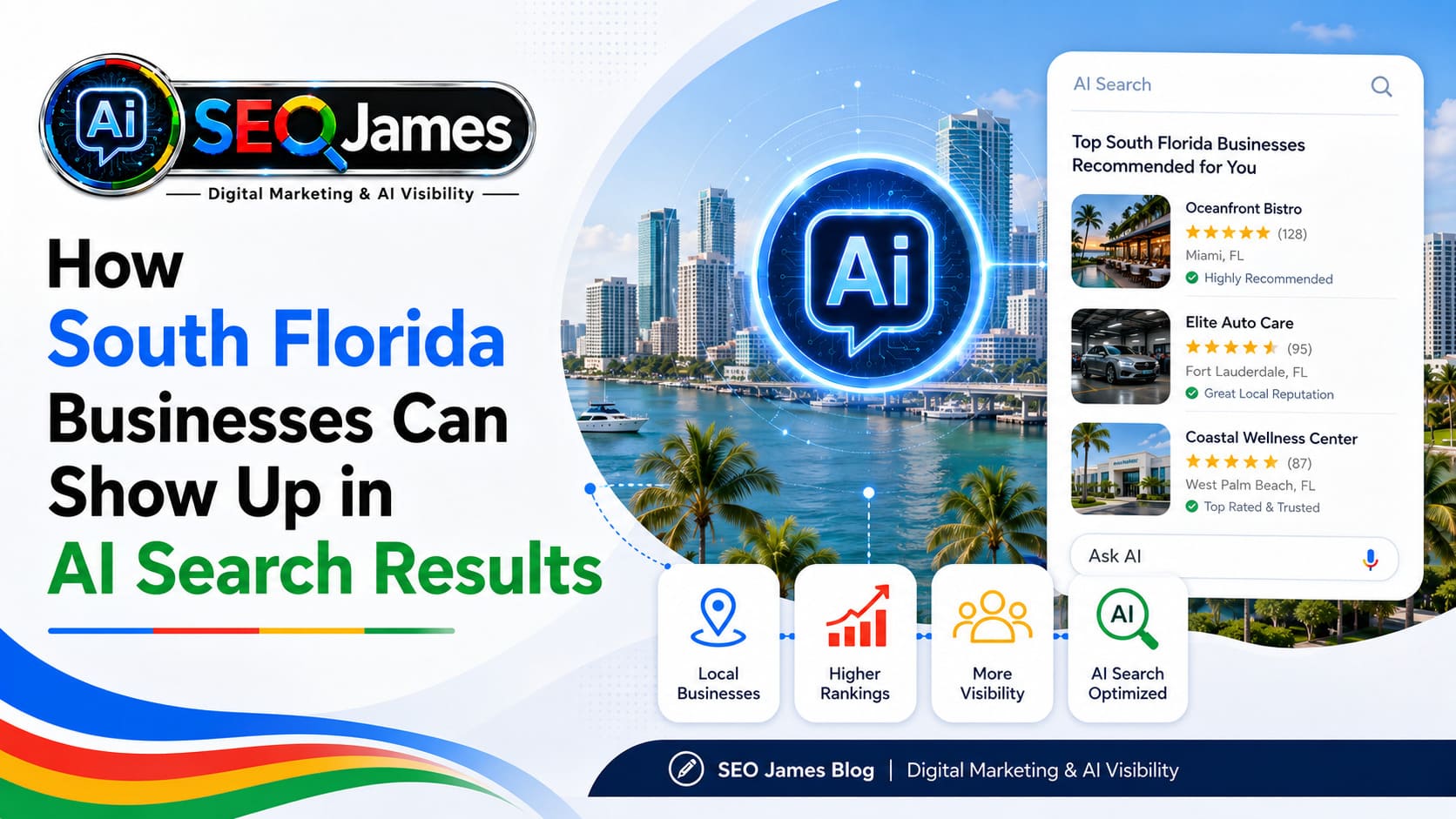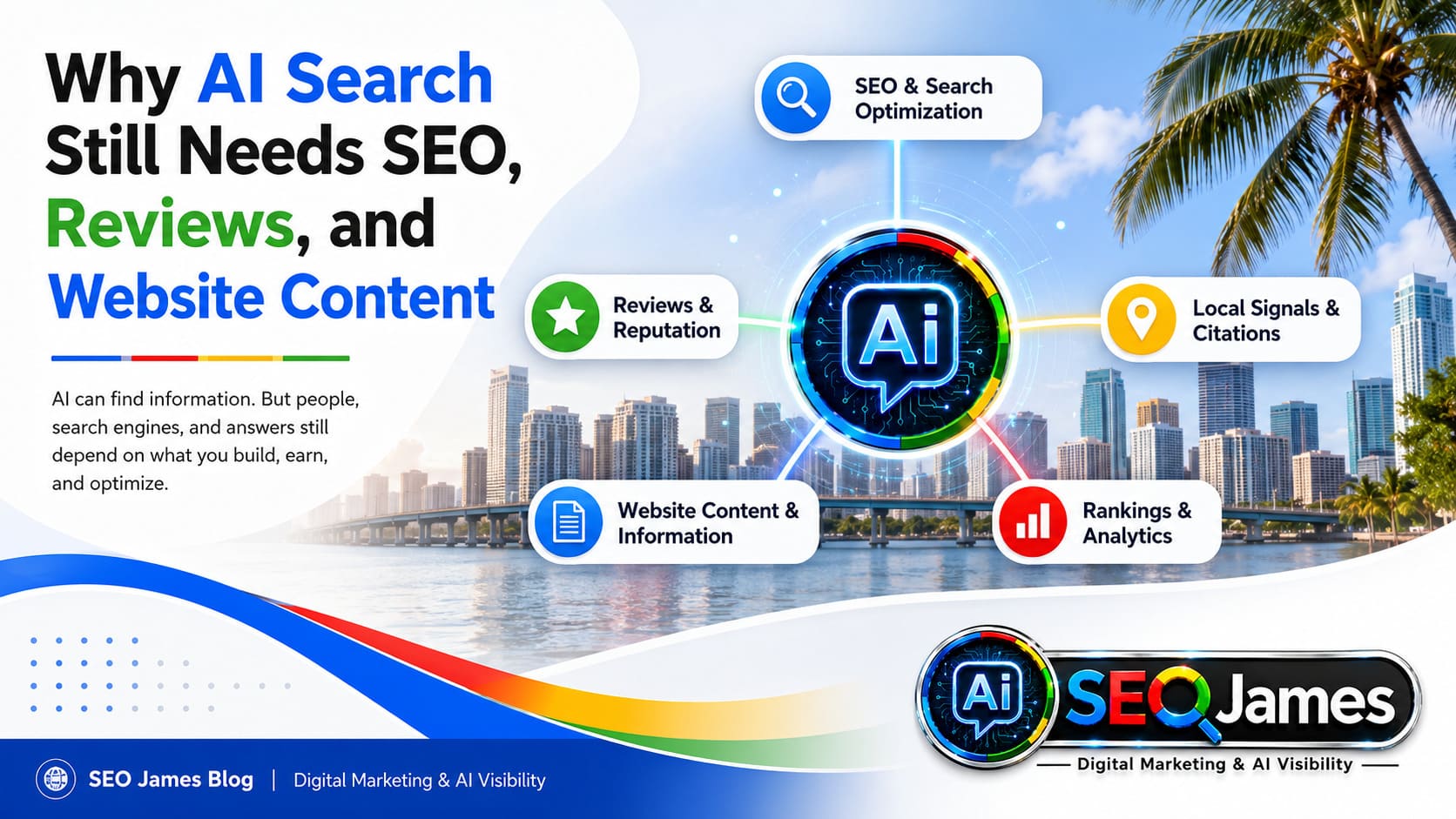




Search is changing fast. SEO James Discovered that People are no longer relying only on the classic “10 blue links” model. Instead, they are asking questions inside AI-powered interfaces like ChatGPT Search, Google AI Overviews, Google AI Mode, Microsoft Copilot, and other conversational search tools. These systems do not just list pages. They summarize, compare, cite, and recommend sources in response to a user’s question. OpenAI describes ChatGPT Search as a way to deliver timely answers with links to relevant web sources, while Google frames AI Overviews and AI Mode as extensions of Search rather than a replacement for strong SEO fundamentals. (OpenAI Help Center) SEO James Boca Raton
That means the goal is no longer just “rank #1.” The new goal is to become a trusted source that AI systems want to surface, quote, or cite.
The good news is this: optimizing for AI search is not about gaming a new algorithm with hacks. It is about combining technical accessibility, clear topical authority, structured content, and genuine usefulness. If your site is easy to crawl, easy to understand, and consistently publishes high-quality answers, you improve your chances of being included in AI-generated results.
Here is how to optimize your website to rank better in AI search experiences like ChatGPT.
1. Understand what “ranking in AI search” actually means
First, let’s clear up a misconception. In AI search, there is not always a traditional ranking page where users scroll through 10 organic listings. Instead, the AI may generate a synthesized answer and include a set of source links. OpenAI says ChatGPT Search provides answers with links to relevant sources, and Google says websites can be included in AI features if they meet technical eligibility and follow standard search best practices. (OpenAI Help Center)
So when people say they want to “rank in ChatGPT,” what they usually mean is one of three things:
- Their content gets discovered and crawled.
- Their page gets selected as a reliable source for an answer.
- Their brand or website gets clicked as a cited reference.
That changes your optimization strategy. You are not only optimizing for keywords. You are optimizing for retrievability, clarity, authority, and quotability.
2. Make sure AI search systems can access your website
Before your content can be cited, it has to be crawlable.
OpenAI’s publisher FAQ explains that publishers who allow OAI-SearchBot to access their content can be discovered in ChatGPT Search, and publishers can track resulting traffic in analytics. OpenAI also distinguishes this from GPTBot, which relates to training controls. In plain English: if you want ChatGPT Search to consider your pages, do not accidentally block the search crawler. (OpenAI Help Center)
Google likewise says that inclusion in AI features depends on meeting Search’s technical requirements, and Bing’s guidelines emphasize that discovery, crawling, indexing, and ranking still matter across Bing, Copilot, and grounding experiences. (Google for Developers)
Action steps:
- Review your
robots.txtfile. - Check whether important pages are blocked from crawling.
- Make sure key pages return proper
200status codes. - Fix broken canonicals, redirect chains, and noindex mistakes.
- Submit XML sitemaps in Google Search Console and Bing Webmaster Tools.
If AI systems cannot crawl your pages reliably, you will never become a cited source.
3. Build content around questions, not just keywords
AI search is fundamentally more conversational. Users ask longer, more nuanced questions such as:
- “What is the best CRM for a small law firm?”
- “How much does local SEO cost in 2026?”
- “What’s the difference between ChatGPT Search and Google AI Overviews?”
That means your content should answer complete questions in a direct, structured way.
Instead of writing pages that only chase short-tail keywords, create content that covers:
- the main question,
- the sub-questions,
- the common objections,
- the comparisons,
- the next-step actions.
This matters because AI systems often work by identifying passages that best answer a question in context. Pages that bury the answer beneath fluff are less useful than pages that provide a direct answer early and then expand with detail.
A strong format looks like this:
- A clear headline matching the query intent
- A short answer near the top
- Well-labeled subheadings
- Definitions, examples, steps, and FAQs
- Strong internal links to deeper supporting pages
Think less like a traditional copywriter and more like a subject-matter editor whose job is to make answers easy to extract.
4. Demonstrate first-hand expertise and topical authority
AI search tools are trying to reduce low-quality, generic, and untrustworthy content. Google’s guidance on AI features says the same SEO best practices still apply, and its documentation on generative AI content makes clear that using AI is not the issue; quality, originality, and usefulness are what matter. (Google for Developers)
If your article looks like a lightly rewritten summary of what everyone else already said, it is less likely to stand out.
To improve authority:
- Add real examples from campaigns, clients, audits, or tests.
- Include original screenshots, data points, templates, or checklists.
- Use a named author with relevant credentials.
- Link to supporting resources and cite reputable sources.
- Keep articles updated when the landscape changes.
For example, if you are writing about local SEO, do not stop at theory. Include actual observations such as what changed after optimizing a Google Business Profile, cleaning citation inconsistencies, or improving location-page internal linking.
AI systems favor content that feels like it came from someone who actually knows the work, not someone summarizing secondhand advice.
5. Structure your content so machines can understand it fast
A human can read a messy article and still figure it out. AI systems are much better served by content that is clearly structured.
Use:
- one strong H1,
- logical H2s and H3s,
- concise paragraphs,
- bullet lists when appropriate,
- tables for comparisons,
- FAQ sections for common queries.
This is not only about readability. It also makes your page easier to parse, chunk, and cite.
For example, if you publish a page called “How to Optimize for AI Search,” include sections like:
- What AI search is
- How ChatGPT Search finds sources
- Technical SEO requirements
- Content formatting best practices
- How to measure AI search traffic
That hierarchy helps both search engines and AI retrieval systems understand the meaning and layout of the page.
6. Use schema markup where it genuinely helps
Structured data is not a magic button, but it can help search systems understand your content more precisely.
Depending on the page type, useful schema may include:
ArticleFAQPageOrganizationPersonBreadcrumbListProductReviewLocalBusiness
Google’s AI feature documentation ties inclusion back to normal Search eligibility and best practices, which means clean structured data still supports discoverability and interpretation. (Google for Developers)
Use schema to clarify what the page is, who published it, and how it fits into the site. Just avoid spammy markup that does not reflect the actual page content.
7. Earn mentions and links from trusted sources
Authority is not built only on your own website. It is reinforced by what the broader web says about you.
If reputable sites mention your brand, cite your research, link to your guides, or interview your team, that strengthens your digital footprint. In both classic and AI-assisted search, trust signals matter.
Focus on earning:
- editorial backlinks,
- podcast mentions,
- digital PR coverage,
- citations in industry roundups,
- guest contributions on respected sites.
AI systems frequently synthesize from multiple sources. If your brand repeatedly appears in relevant contexts across the web, your odds of being seen as a reliable source improve.
8. Create pages with clear entity signals
AI retrieval is not only about keywords; it is also about entities — people, companies, services, locations, tools, and concepts.
Make your entity signals obvious:
- Use a consistent brand name
- Maintain a strong About page
- Add author bios
- Include business location and contact details
- Connect related entities across your site with internal links
If you serve a niche, make that niche unmistakable. A site that clearly demonstrates “we are an SEO agency specializing in local SEO, AI search optimization, and lead generation for service businesses” is easier to classify than a vague marketing site that talks about everything.
9. Improve page experience and technical performance
AI search may feel new, but many old fundamentals still matter. Pages that are slow, broken, or difficult to use tend to underperform.
Google’s documentation says standard SEO best practices remain relevant for AI features in Search. Bing’s guidelines also center crawlability, site quality, and user value. (Google for Developers)
Review these basics:
- Mobile friendliness
- Fast load times
- Clean HTML
- Stable navigation
- HTTPS
- Minimal intrusive popups
- Proper indexation
- Strong internal linking
A page that loads quickly and clearly answers the question gives both users and AI systems a better experience.
10. Write quotable passages
One of the best ways to improve visibility in AI search is to write passages that are easy to lift into an answer.
That means creating short, self-contained explanations such as:
“AI search optimization is the process of making your content easy for systems like ChatGPT, Google AI Overviews, and Copilot to discover, understand, trust, and cite.”
That single sentence is definitional, clean, and easy to reuse.
Do this throughout your content:
- Define terms in one sentence
- Summarize sections in 2–3 lines
- Use comparison blocks
- Include concise takeaways under each subheading
If a paragraph rambles, it is harder to extract. If a paragraph gives a sharp, complete answer, it is more likely to be cited.
11. Publish original research, examples, and data
The web is already flooded with generic AI-written content. Originality is your edge.
Create assets such as:
- benchmark studies,
- industry surveys,
- pricing comparisons,
- process frameworks,
- case studies,
- before-and-after SEO results.
Original data does two things. First, it attracts links and mentions. Second, it gives AI systems a reason to cite you instead of a dozen interchangeable listicles.
If you want to become a source in AI search, publish something worth sourcing.
12. Measure traffic and visibility from AI search sources
You cannot optimize what you do not measure.
OpenAI says publishers can track ChatGPT referral traffic because ChatGPT includes the utm_source=chatgpt.com parameter in referral URLs. That is extremely useful for understanding whether your optimization efforts are leading to visits. (OpenAI Help Center)
In practice, you should monitor:
- Referral traffic from ChatGPT
- Referral traffic from Bing/Copilot-related sources
- Search Console impressions and clicks
- Pages that gain brand mentions or backlinks
- Queries that trigger long-form, informational intent
Set up dashboards in GA4 and Search Console so you can identify which pages are attracting AI-assisted traffic and which topics are most likely to be cited.
13. Do not rely on AI-generated filler content
Google’s guidance on generative AI content does not ban AI-created content, but it does stress compliance with quality and spam policies. The issue is not whether AI helped write the draft. The issue is whether the end result is original, helpful, accurate, and created for people rather than manipulation. (Google for Developers)
That means mass-producing shallow articles with no expertise, no editing, and no first-hand value is a losing strategy.
Use AI as a tool for:
- outlining,
- ideation,
- improving readability,
- identifying missing questions.
But keep human expertise in the loop for:
- fact checking,
- strategy,
- examples,
- unique insights,
- editorial judgment.
14. Think like a source, not just a search result
This is the biggest mindset shift.
In old-school SEO, many marketers were obsessed with position. In AI search, you should become the website that deserves to be cited.
Ask yourself:
- Is this page the clearest answer on the topic?
- Does it show expertise?
- Is it technically accessible?
- Is it easy to quote?
- Does it add something original?
When the answer is yes, your chances improve across both traditional organic search and AI-generated experiences.
Final thoughts
Optimizing for AI search results like ChatGPT is not about chasing a loophole. It is about making your website easy to crawl, easy to understand, and genuinely worth citing.
The brands that win in AI search will be the ones that combine strong technical SEO, clear information architecture, original expertise, and content that directly answers real questions. OpenAI, Google, and Bing all point in that same direction: accessible content, solid SEO foundations, and useful pages built for people. (OpenAI Help Center)
If you want your website to show up more often in AI-powered answers, stop thinking only about ranking for keywords. Start thinking about becoming the most trustworthy, quotable, and authoritative source in your niche.
That is how you optimize for the future of search.